Notes on Serial Experiments Lain
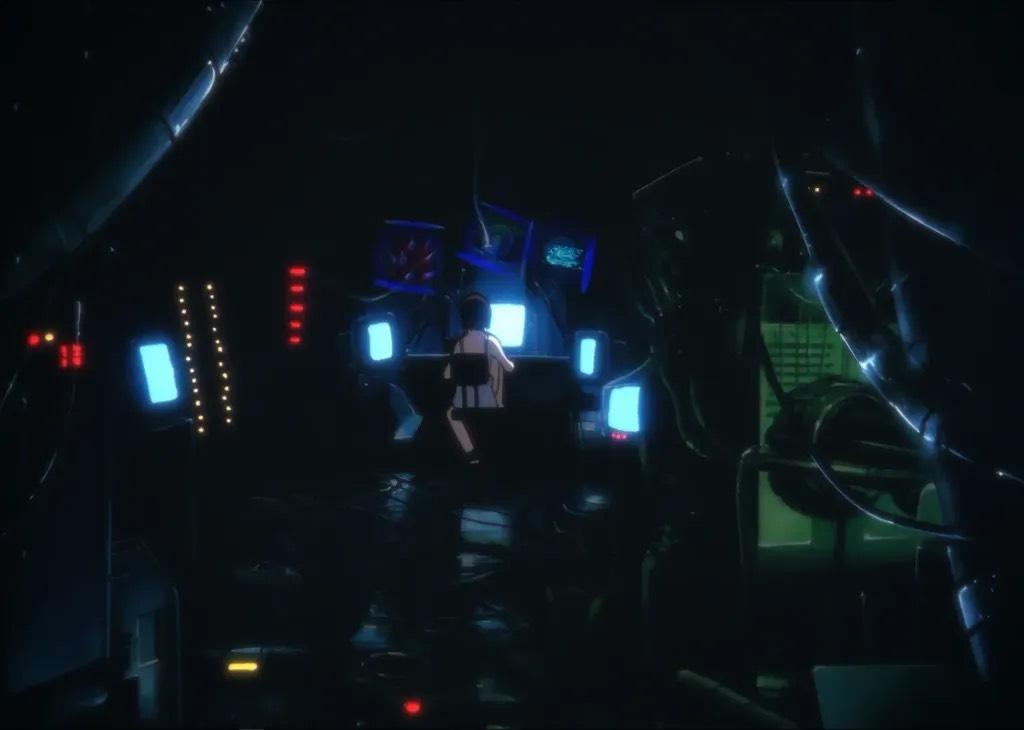
Serial Experiments Lain is a cult-classic 1998 anime series about the internet, alienation, and who we are evolving into. Lain takes an unyielding look at what computers are doing to us and predicts, with ice-cold sharpness, the emotional and spiritual contours of the digitalized world we now mistake for ordinary life. Radiohead’s OK Computer, released the year before and touching on many of the same themes, gave us a pig in a cage on antibiotics; Lain gave us cyberized doppelgängers rewriting the collective unconscious. Both realized that the internet was coming at us faster than anyone would ever believe, and that it was going to first consume, and then try to replace, the entire world.
Lain is dense, ambiguous, and will leave you behind without a second thought if you aren't leaning in and parsing every line. Without active attention and occasional note-taking, it's easy to dismiss the series as being weird for weird's sake. The pedal is pushed to the floor from the very first episodes, and we're given full-on immersion in a world where the bounds between the possible and the impossible, the material and the mental, are rapidly dissolving. It is not a show that opens itself to a distracted viewer.
The story opens with a suicide. Middle-schooler Chisa Yomoda, egged on by something unseen, leaps to her death from a Shibuya high-rise. Lain Iwakura, a schoolmate and our main character, hears about this first when other students mention that they’ve started receiving cryptic emails from Yomoda. Lain, socially isolated and whisper-quiet, wonders whether she’s gotten one. Our protagonist isn’t very interested in Navis (computers, in the show’s parlance), but her curiosity propels her to dust off the kid’s model she has at home and check her inbox.
And there it is: a message from the dead girl. ”I have only given up my body. By doing this, I can explain to you that I am still alive…You will all understand soon. Everyone will.” Viewers watching today understand exactly what she means. Lain, stranded at the turn of the millennium, does not.
It would be a disservice to the ambiguities and ghosts inherent to the source material to spend this essay restating the rest of the story. Suffice it to say that the series progressively pulls Lain and the viewer deeper into the darkness of the Wired (as the show calls the internet). What I will do here, and what I believe better serves the spirit of the show, is trace some common themes and investigate why they’re still relevant, and why I believe Lain has earned its place as one of the greatest, and most true, anime of all time.
There will be unmarked spoilers throughout.
The Internet is a World
The core mechanic of the Wired in Serial Experiments Lain is that it is inhabitable. It is not merely a tool or a technology; it is a real place that you can go to. The better your Navi and the more processing power you have—in the show’s visual language, the more leaking coolant tubes and screaming pressure gauges—the more completely you can embody yourself in it.
Yomoda’s suicide is not just an introduction to this idea; it is its most complete expression. As Yomoda communicates from beyond the grave, the Wired was a better home for her than our world. So she jumped to remove herself, and is now asking others to follow her. She is trying to show them that the Wired has room for them, too. Lain, a little unsettled but mostly intrigued, immediately gets to work in upgrading her computer to get closer to Yomoda, the Wired, and an understanding of how this all could be possible.
It’s not long before Lain's father warns her, in Layer (episode) 04, about not forgetting the real world for the Wired. Lain deadpans, “Soon I’ll be able to enter it.” “You couldn’t,” he responds. Couldn’t, not shouldn’t. He is envious. He wishes he could step inside, like Yomoda stepped inside, and like Lain is trying to. The terrifying thing isn’t even that this view of the internet as a place to live was correct, so many years before virtual spaces like Second Life started to appear—it’s that such a view is today considered uncontroversial, even banal.
When I first watched Lain in the early 2010s, I have to admit that I didn’t really get it. With this year’s rewatch, I’ve realized that’s because we hadn’t fully bridged the gap yet. Sure, Instagram was already popular and everyone’s grandparents had kinda-sorta begun disappearing into Facebook, but those platforms weren’t yet the makers of reality. They still only reflected and described it. Mirrored it.
But today, anyone who spends fewer waking hours in face-to-face conversation than in comments sections, or who has gone to a restaurant only to share photos of the food rather than eat it, knows that the metaverse, the Wired, has finally closed the loop. It is no longer something we use. It is somewhere we are. Our attention lives there. Increasingly, the version of ourselves we find most real—the one that is witty, photogenic, ideologically consistent—lives there too, while the meat-body shuffles around making coffee and paying rent on its behalf. Lain called this out nearly thirty years ago and proposed not merely that the internet would become a place, but that it would become a place emotionally preferable to reality.
As the series progresses, Lain’s version of the web, too, stops being something to climb into and starts being something that reorders reality. It shifts from something created into something creating. As Lain pursues ever more Cronenbergian upgrades to her computer, we see her slowly gain the ability to manipulate the fabric of the Wired. And because of the porousness of the veil in her world, that power translates to direct control over reality. It’s later implied that Lain herself isn’t even real; she’s just an algorithm, software, made flesh and planted into a house of paid actors.
In the cosmology of Serial Experiments Lain, humans are the demiurge of the web. And then the web, embodied, becomes the master of humans.
Which Self?
If the Wired is a world we inhabit, who are we when we're inside it?
Over the course of Serial Experiments, we learn that there are at least three distinct versions of our protagonist: our timid, almost catatonic schoolgirl; an assertive, slick hacker operating deep within the Wired; and a vengeful, spectral Lain who acts as a laughing trickster god. These three aspects are the crystallizations of Lain’s crowd-sourced identities, shaped by the expectations of those who interact with them. Lain is ‘Just Lain’ to her classmates and family, ‘Wired Lain’ to the hackers and freaks of the deepweb, and eventually ‘Evil Lain’ to all the people the other two have wronged—including themselves. Shades of David Lynch.
It’s not just Lain, and not just fiction: everyone with a username is a Rashomon's worth of outside perceptions, frozen in time by HTML. Lain questions whether there is such a thing as a "true" self, or whether we are merely a collection of data points and perceptions held by others. If your digital self is more influential, more visible than your physical self, which one of you is more real? Lain articulates that terrifying sensation of feeling achingly hollow in the physical world but overwhelmingly full in the digital one.
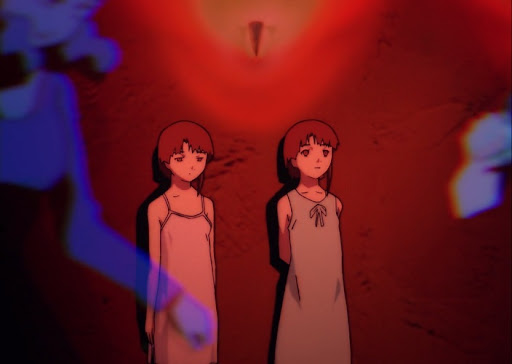
The snapshotting of identity inherent to the internet is particularly insidious, perhaps even more so than its splintering. Once uploaded, every version of you persists forever. Past-you has already spoken, been screencapped, and current-you is now expected to honor those prior commitments forever. This is not a small thing. It is, I'd argue, one of the key mechanisms behind the social intransigence that defines our lives now. We cannot walk anything back without being accused of incoherence by the disembodied heads floating around the Wired.
Lain got it right when it proposed that these shades of self can try to destroy you. We see the aggressive digital Lain hijacking the timid Lain's real-world relationships, revealing her friends' deepest secrets and systematically destroying her social standing. Is this not exactly what we fear today? That our digital ghosts will step out of the screen and ruin our physical lives?
"I don't know whether or not there's another me in the Wired, but there's definitely no other me here in the real world," offers Lain in Layer 09. We wince, because we know it isn't true. We’ve seen and felt significant evidence to the contrary.
As we near the end of the run, Lain’s not so sure herself. She has begun watching herself entirely from the outside, replaying the events of the series. Layer 11 is a clip-show recitation of everything that has come before, but with Lain herself watching all the events as an It’s A Wonderful Life-style ghost. She witnesses Yomoda’s suicide as if she were there. Was she? Her depersonalization, the scattering of herself to the winds of the Wired, is complete.
Alien Nation
So: the Wired is a world, and it is a world that shatters the self. Why, then, would anyone choose to go there? Because for some people, the physical world was never an option.
Lain’s distinguishing personality traits are alienation and disconnection. From the first time we see her to the last frame of the last episode, Lain finds herself at a huge emotional distance from everyone around her. It’s easy to imagine that her initial curiosity in investigating those ghostly emails is subordinate to her intense desire to be included in something her classmates are also part of, or the simpler wish of just getting a message from another girl.
To fully underline this point, we at one point get a fleeting glimpse of a stereotypical gray alien peering into Lain’s room. It’s played like a moment of weird levity, until we recognize the alien’s mannerisms and shyness, and indeed, its silent creepiness, as Lain’s. Later on, Lain even briefly assumes the form of the alien when she, like a visitor from another planet, secretly checks in on another character from afar.
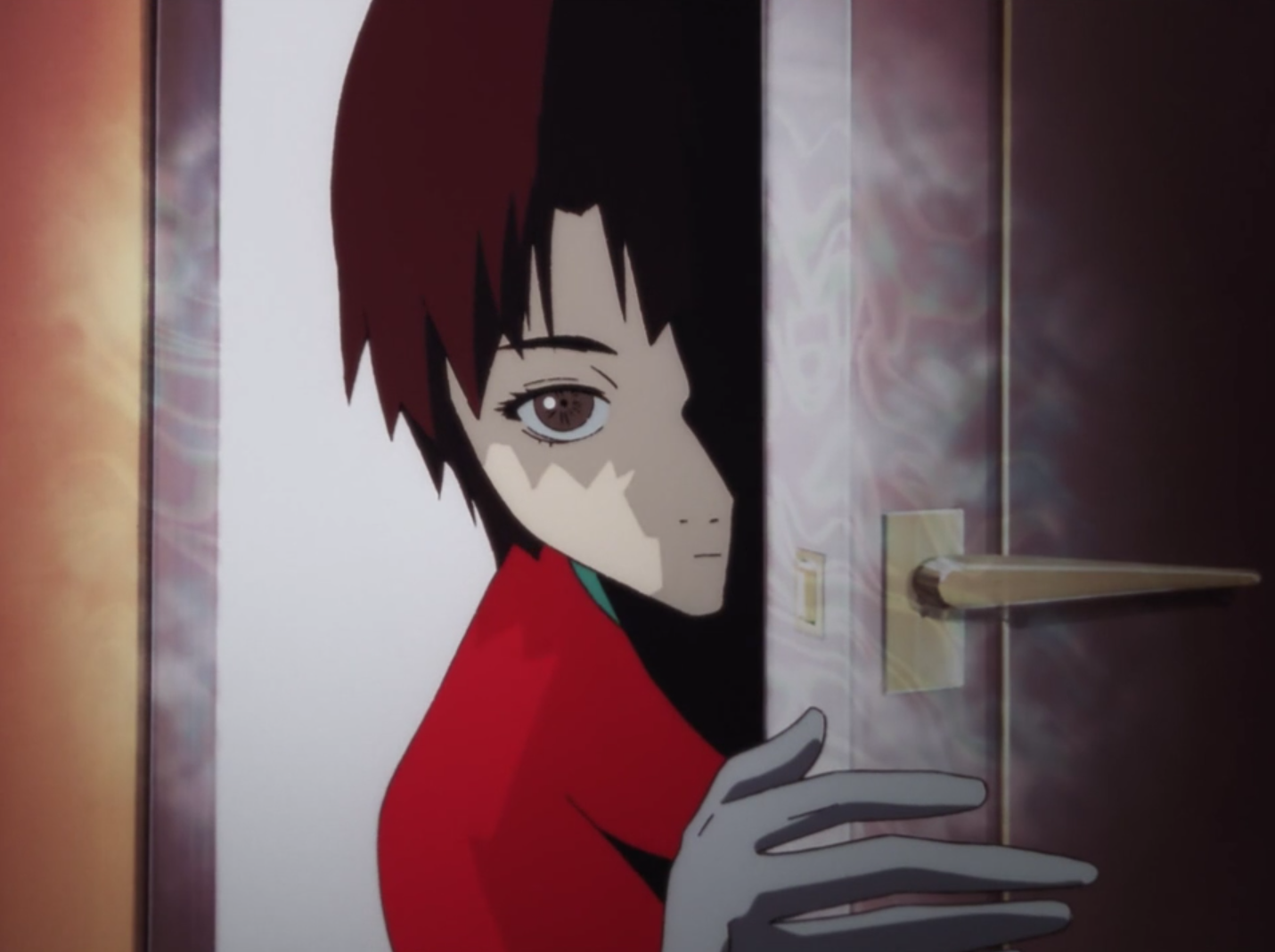
It is only natural, then, that the Wired, this alternate world, would be attractive to the aliens who don’t feel at home in this one. It is only natural that it would act as a whirlpool into which some disaffected people jumped willingly, before it eventually became one into which everyone else fell just because. One of the few times we see Lain really laugh is in an early episode when she floats for the first time through the Wired, giddy, disembodied, entertained by all the empty words from nameless strangers that float across the screen.
Here is a good place to mention that the tagline for Serial Experiments Lain was “Close the world. Open the next.”
But the show doesn't just offer surrender. As in Lain’s world so in ours, there are still moments of true emotional connection. Lain’s first attempt at connecting with her (living) peers happens in Layer 02, when three popular, well-adjusted classmates—Alice, Juri, and Reika—notice Lain’s awkwardness and decide that they can help her come out of her shell. They also decide they want to hear more about Lain making a name for herself as a powerful hacker online. Lain doesn’t really know what they’re talking about (our first clue to the existence of ‘Wired Lain’), but she chooses to get closer and lets herself be invited out to dance with them.
At the Cyberia club that night, Lain briefly tastes what it’s like to be a normal girl and not an extraterrestrial. She takes off her trademark teddy bear hat and pretends to enjoy the music. But then a shot rings out, a body falls to the ground, and the peace and acceptance are destroyed. The gunman aims at Lain in pure terror of her (or her menacing doppelgänger?), before turning the gun on himself. Lain is close enough that his blood splatters on her face. Her expression doesn’t change.
Afterwards, at the police station, Alice rushes in and tearfully, hysterically, embraces Lain. Will Lain ever forgive her? From this point on, Alice commits to being Lain’s friend, and to taking care of her no matter what. We imagine Lain confused but hopeful. This is the key moment when Lain’s desire to be close to other people is most acutely expressed, in a soft murmur of “A-ri-su…”[1]
But then, the hammer comes down and the show’s coldness is fully revealed for the first time: Lain comes home to an empty house. There is no one around to support her. So where does she turn? Her Navi. The Wired. Only her computer is there to tell her good night.
This brutal isolation drives home the core emotional thesis of Serial Experiments Lain: When the pain of being misunderstood by those around you is so great, why wouldn’t you turn to the frictionless love offered by strangers instead of the messy one offered by your real friends and family? What if your friends leave you, and your family doesn’t feel like your real family at all? Lain probes these questions like a tongue probes a missing tooth.
Fans of existentialism will immediately recognize this as the hedgehog’s dilemma, which posits that all striving for warmth from others will, like hedgehogs trying to keep warm in a huddle, inevitably lead to puncture wounds. Neon Genesis Evangelion, Lain's closest sibling among prophetic late-90s anime, ultimately argues that the warmth is worth it. That to be close to another person is the only project that matters, even if it scars you.
How to resolve the hedgehog's dilemma looms large for us in the real world, too. Is Lain’s answer, to climb into the Wired, not, in essence, the same one chosen by the hikikomori? Once a uniquely Japanese phenomenon of permanent separateness aided and abetted by access to infinitely fulfilling digital content, it is a phenomenon slowly spreading through the wider world. In many ways, Japan was just the canary in the coal mine for many pathologies of the digital era: hikikomori syndrome, the industrialization of parasocial relationships, rent-a-family services for the funerals of people whose real families wouldn't come.
Except now it’s everywhere. Ever more people are opting out of proximity for fear of the pain. In our hypermediated, distanced, contingent age, the illusion of infinite choice leads to a dangerous predilection for cutting off any relationship that might chafe or poke while ceaselessly searching for one that doesn’t. Turns out, they don’t exist. And then you freeze.
This choice between these two branching pathways, toward humanity or toward cyberspace, recurs throughout Lain. In Layer 11, Alice goes to Lain’s house—at that point, a ruined, leaking shell housing only Lain and her monolithic Navi—to find out just what’s been going on with all those alternate Lains, and to fulfill her promise to protect and care for the real one. At this point, our main character has given up on reality, deciding to retreat forever into the Wired.
Alice finds her friend wet, cold, and covered in wires. As the emaciated Lain tries to explain to Alice that humans no longer need a physical body to stay alive, eerily mirroring Yomoda, Alice stops Lain mid-sentence by grabbing her hand and placing it over her heart. That heartbeat, that simplest refutation, illuminates these dark final episodes and gives Lain the power to resist the siren call of the Wired—at least for a while. It is the only thing that breaks through the digital veil. Alice is the refusal of the hedgehog's retreat, the person willing to be pricked. She is what proves that the warmth is worth it.
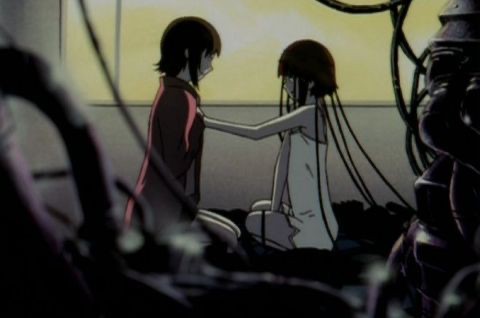
Tragically, characteristically, this warmth is not permanent. As Lain continues to amass powers that spill into meatspace, we see that having the capacity to rewrite the world doesn’t put Lain any closer to feeling at home inside it. If anything, it forces her further away. Lain’s abilities are wielded by a hurt, confused middle-schooler who doesn’t have the depth of experience necessary to realize when she’s been offered the better alternative. Lain’s confusions are existential, and so her means of remedying them are equally existential.
Lain’s ultimate answer, proffered in the final episode, is therefore more ambivalent than Evangelion's. Deciding that the world would have been better off without her in it (and dovetailing with her understanding that she might be the Wired embodied), Lain wipes herself from the world’s collective memory. She chooses to instead serve as an eternal silent observer, a creature forever forgoing the struggle of proximity. An alien at last.
Throughout this self-erasure, the one face that keeps reappearing to Lain is Alice’s; the only thing she wants undone is the pain she has caused her. One of the hidden truths of Serial Experiments, and the one that cements it as an edifying, albeit troubling, retelling of the hedgehog problem, is that Lain might be doing all of this—manipulating reality, rewriting it, deleting herself—just to regain Alice’s love. The most painful part is that she already had it.
The Apocalypse
At the end of the day, Serial Experiments Lain is not a happy story, but it is a vital one. Its unhappiest fact, its deepest horror, is that the ultimate apocalyptic scenario it imagines—reality merging with the internet—is the reality that we are all living in. The story of a digital world at first mirroring and then rewriting the real one is no longer just a story. It is the animating principle of modern social, economic, and political life.
Serial Experiments understood that this apocalypse, unlike all those predictions of nuclear fire or robot uprisings, would certainly come to pass because it would be attractive. Because it wouldn’t feel like an apocalypse at all; rather, it would feel like coming home. The end of our world looks like checking our phones. Like not going out. Like becoming aliens.
In the series, those extremists who fight to tear down the wall between the world and the web believe that collapsing existence into a field of pure information would allow humans to evolve into something greater. Those extremists exist here, too. At first, they were just a few Silicon Valley techno-utopians. But now, it’s anyone who has embraced the primacy of the metaverse and forgotten the heartbeat of others. It is a grim fate, and it is spreading.
We should have known. Every episode of Lain opens with a warning:
“Present Day. Present Time.”
All images © NBCUniversal Entertainment Japan
[1] Here, I was reminded of The OA, a cult series that uses an entire existential sci-fi drama as a Trojan horse to smuggle in a brutal depiction of a mass shooting. We see the weirdness of using fiction to confront these moments, a method utilized by both series, in Alice’s reaction to her show’s violence: “It’s strange that we can’t take it seriously… it’s like we were watching a movie.” It’s a throwaway line that perfectly summarizes modern, hypernetworked reactions to murder and death, showing just how obvious this analysis was to the writers even before Columbine.